Eagle Team M.A.R.VI.N. (concept design)
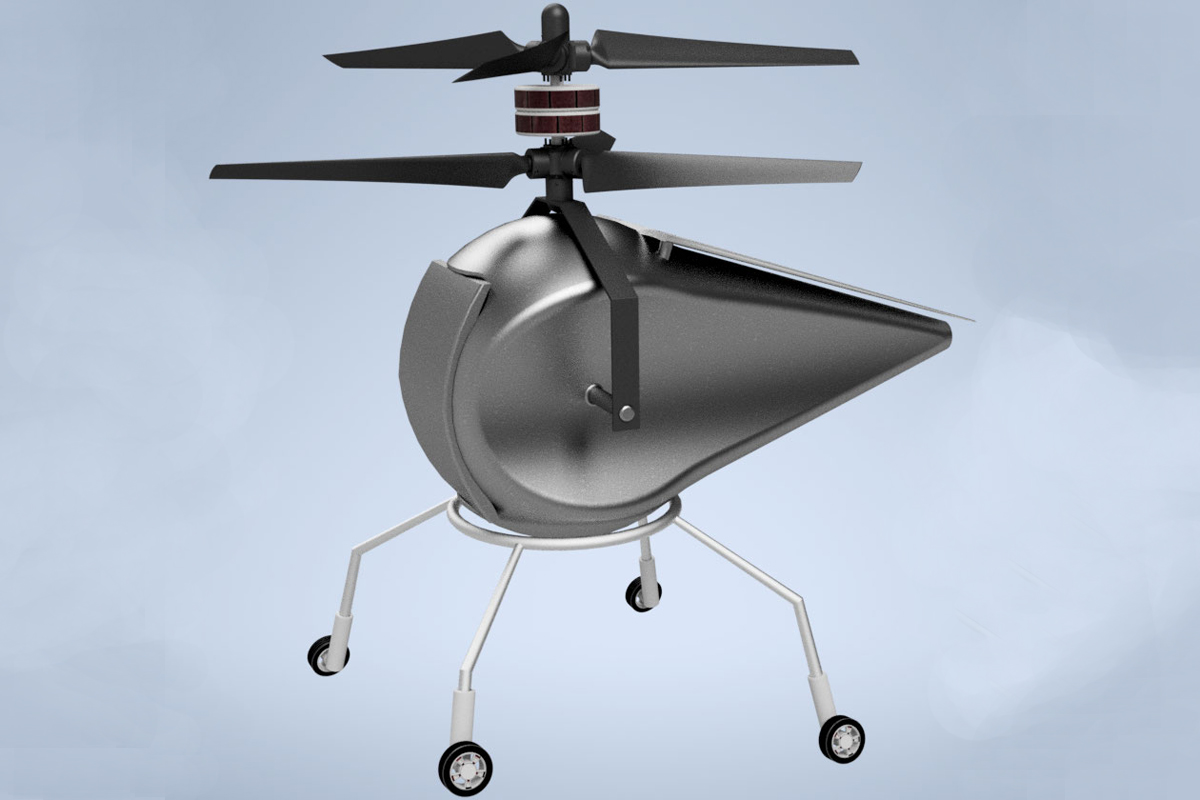
(Image credit: Eagle Team)
M.A.R.VI.N. (concept design)
Eagle Team
Cranberry Township, Pennsylvania, USA
website unknown
The Eagle Team is a global group of people who are from or living in the United States, Brazil, India, the United Kingdom and Italy. The Team Lead is Duane Larson and the remainder of the team includes Vishruth Balaji, Parisa Soheili, Mark Rumsey, Gabriele Stagnaro, Vaibhav Sharma, Hector Olono, Raissa Macedo, Hari Venkataraman and Vanshdeep Mahajan. The team's philosophy is, "If you want the world to change, you have to change the world!”
The Eagle Team entered the GoAERO competition with its Mission Adaptable Rescue Vehicle Network (M.A.R.VI.N) emergency response hybrid-electric helicopter concept design. Although the team was not selected as a Stage 1 or Stage 2 prize winner, the project demonstrated the team's approach to emergency response electric helicopter design.
M.A.R.VI.N. autonomous passenger emergency rescue hybrid-electric helicopter (concept design)
The Mission Adaptable Rescue Vehicle Network (M.A.R.VI.N.) is an autonomous one passenger emergency rescue hybrid-electric helicopter. The team states their helicopter will be a low-cost, long-range, heavy payload and cutting-edge emergency helicopter that provides extended loiter time for search and rescue (SAR) missions. The team promises their helicopter has no limits when rescuing survivors in a disaster zone and their helicopter can rescue people no matter how dangerous the scenario.
The helicopter has coaxial counterrotating main propellers, each propeller has three rotorblades. The main rotor system has the ability to tilt for more precise flying in multiple types of weather and other dangerous conditions. The concept design also has wings to increase the range of the helicopter. The helicopter has two electric motors and is powered by a hybrid-electric power source. The fuselage is made from carbon fiber composite to give the aircraft a high strength to low weight ratio. The helicopter has fixed quadricycle wheeled landing gear.
About the GoAERO Prize Competition
The GoAERO Prize, sponsored by Boeing, is a three year competition (2024-2027) offering over $2 million USD in prizes that challenges engineers worldwide to create portable, versatile and autonomy-enabled Emergency Response Aircraft that address not only everyday medical emergencies but also to be used in natural disasters, humanitarian emergencies and climate crises worldwide. Each team designs and builds autonomous Emergency Response aircraft capable of delivering a first responder, medical equipment and supplies and ultimately evacuating victims in need to a rescue ambulance or hospital.
More than 150 teams from around the globe are competing for the GoAero prizes. The GoFly and GoAERO prizes were developed by Boeing, NASA and other organizations to help the nascent advanced air mobility (AAM) industry move forward.
Specifications:
- Aircraft type: Passenger emergency rescue hybrid-electric helicopter (concept design)
- Piloting: Autonomous
- Capacity: 1 passenger and/or emergency equipment
- Cruise speed: Unknown
- Propellers: 2 main propellers (each with 3 propellers) tilting main rotor system
- Electric motors: 2 electric motors
- Power source: Hybrid-electric power source
- Fuselage: Carbon fiber composite
- Wings: Folding wings
- Tail: 1 V shaped helicopter tail that acts as a rudder
- Landing gear: Fixed quadricycle wheeled landing gear
- Safety features: There are redundancies of critical components in the sub-systems of the aircraft providing safety through redundancy. In case of an in-flight loss of power, the helicopter can autorotate and land safely.
Resources:
- Eagle Team website unknown
- Article: Meet the Teams: EAGLE TEAM, GoAero, May 21, 2025
Recent Pages
- aeroG Aviation AG-8 (concept design)
- NASA Tiltwing-Two (illustration)
- CoolFly Urban 4 (concept design)
- CoolFly Standing Flight Platform (prototype)
- CoolFly Urban 3 (prototype)
- CoolFly Urban 2 (concept design)
- CoolFly Urban (production model)
- CoolFly Dream ST (production model)
- CoolFly Dream Pro (production model)
- CoolFly Dream (prototype)