Zuri TD 2.0 (technology demonstrator)
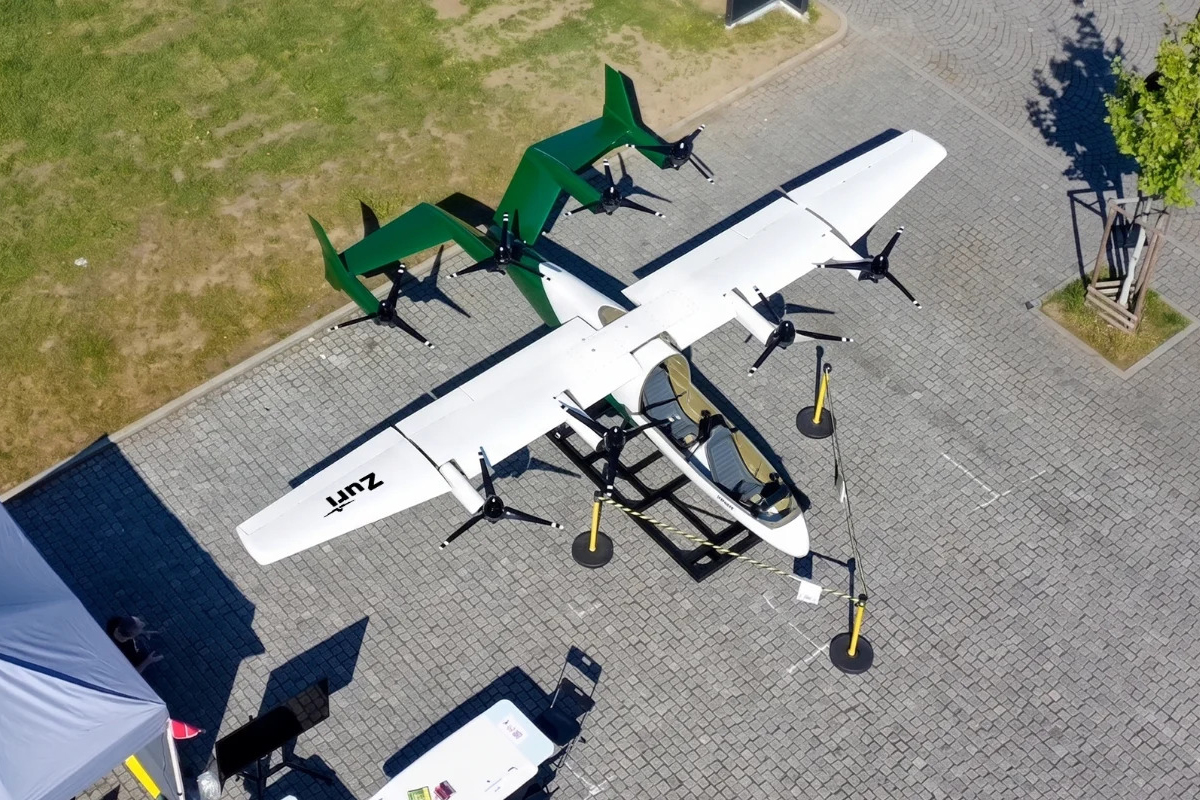
(Photo credit: Zuri)
TD 2.0 (technology demonstrator)
Zuri SE
Prague, Czech Republic
www.zuri.com
In 2017, Czech entrepreneur Michal Illich began his start-up company and conceptualized an aircraft with wings using hybrid-electric vertical takeoff and landing (VTOL) technology for advanced air mobility (AAM) between two cities (intercity flights). Illich has stated he started his company due to his frustration with the length of time it takes to fly between two fairly close cities using commercial jets.
Funding History (list may be incomplete):
- October 2018: Pale Fire Capital invests €600,000.00
- March 2019: Kiwi.com invests €200,000.00
- May 2021: Angel investors Marek Rosa of GoodAI and Zdeněk Polách of Kaora invested a total of €300,000.00
- October 2021: Six angel investors added €1.3 million. Jaroslav Beck led with €750,000.00 the other angels added €550,000.00
- December 2024: €3 million was added in pre-Series A, oversubscribed, taking the round to €4.4 million, backed by Jan Barta and Boris Renski (founder of FreedomFi and Mirantis), Matej Turek’s 10X fund, amoung others
- August 2026: The company is currently seeking €6 million in its Series A round to support the development of its hybrid VTOL aircraft.
Zuri TD 2.0 uncrewed hybrid-electric VTOL aircraft (technology demonstrator)
The Zuri TD 2.0 is a remotely piloted uncrewed hybrid-electric VTOL technology demonstrator aircraft. The aircraft has two seats but according to the company's website, the aircraft will not be crewed. The technology demonstrator is an aircraft built from the knowledge of Zuri's previous fifteen different aircraft designed, built and flown. The goal for the technologies demonstrator is to validate the hybrid-electric powertrain, tilt-mechanisms, energy management, redundancy, hover, transition, and cruise flight. The company expects the first flight of the aircraft to take place in 2027.
The technology demonstrator has a canopy over the cockpit. The cruise speed is anticipated to be 200 km/h (124 mph), a projected range of 200-250 km (124-155 m) and has a calculated maximum takeoff weight of 690 kg (1,521 lb). The aircraft has eight tilt-propellers, eight electric motors and uses a hybrid-electric power source. The aircraft has one high main wing and has a modified V-tail configuration with twin horizontal stabilizers, each incorporating bidirectional winglets extending vertically upward and downward. The fuselage is metal. The company states that working with metal is faster and allows quicker design changes if needed. The aircraft has fixed wheeled tricycle landing gear.
Specifications:
- Aircraft type: Uncrewed hybrid-electric VTOL aircraft (technology demonstrator)
- Piloting: Remotely piloted
- Cruise speed: 200 km/h (124 mph)
- Range: 200-250 km (124-155 m)
- Maximum takeoff weight: 690 kg (1,521 lb)
- Propellers: 8 tilt-propellers
- Electric motors: 8 electric motors
- Power source: Hybrid-electric power source
- Fuselage: Metal fuselage
- Window: Canopy over cockpit
- Wings: 1 high main wing
- Tail: 1 v-tail with horizontal stabilizers located at the top of the v with winglets
- Landing gear: Fixed tricycle wheeled landing gear
- Safety features: Distributed Electric Propulsion (DEP) uses multiple propellers or electric ducted fans, each powered by electric motors, to increase safety through redundancy. If one or more components fail, the remaining ones can still ensure a safe landing. There are also redundancies of critical components in the sub-systems of the aircraft providing safety through redundancy. Having multiple redundant systems on any aircraft decreases having any single point of failure.
Related Aircraft:
- Zuri (concept design)
- Zuri Cargo (production model)
- Zuri 2.0 (concept design)
- Zuri TD 1.0 (technology demonstrator)
Company Insights:
Resources:
- Zuri website
- Zuri Facebook
- Zuri X (formerly Twitter)
- Zuri YouTube Channel
- Zuri Instagram
- Zuri LinkedIn
- Video: Helicopter + plane = Zuri. Take a look at the Czech machine of the future, Forbes Česko, June 18, 2019
- Article: The first shots of the Zuri aircraft with a vertical takeoff. Illich is getting into the air with him, Forbes, Sept. 8, 2021
- Article: Zuri VTOL demonstrator starts its tests at the airport, 50 Sky Shades, Sept. 20, 2021
- Video: Longest + Highest: ZURI 11-Meter Demonstrator Breaks Its Records, Zuri VTOL, Oct. 23, 2023
- Article: ZURI shares latest video which shows company’s highest and longest test flight of its hybrid-electric VTOL prototype, eVTOL Insights, Oct. 23, 2023
- Video: Precision Testing | Inside Zuri's VTOL Flight Trials, Zuri Hybrid VTOL, Sept. 5, 2024
- Video: Successful Vertical to Cruise Transition Test | Zuri Subscale VTOL, Zuri Hybrid VTOL, Apr. 7, 2025
- Video: Hybrid-electric tiltrotor: an investor questions the Zuri CEO, Zuri Hybrid VTOL, July 30, 2026
- Article: Czech firm Zuri reveals ITAR-free hybrid-electric cargo tiltrotor drone, Aerospace Global News, Aug. 28, 2026
- Article: Zuri Reveals an Uncrewed Cargo Tiltrotor for Offshore and Relief, Migflug, Aug. 30, 2026

Recent Pages
- Zuri TD 2.0 (technology demonstrator)
- Wuhan Xunqi Technology V1000B (prototype)
- Wuhan Xunqi Technology V1000A (prototype)
- Dragale Aviation DX-1 AyuRatha (concept design)
- Dragale Aviation eVTOL Air Ambulance (concept design)
- Dragale Aviation AYUDX2 (concept design)
- Skyfly Technologies Longbow (concept design)
- Skyfly Technologies Axe (production prototype)
- Alef Aeronautics Model Zero Ultralight (pre-production model)
- SMD Shenzhen Smart Drone UAV Bullet (production model)