EHang VT35 (production model)
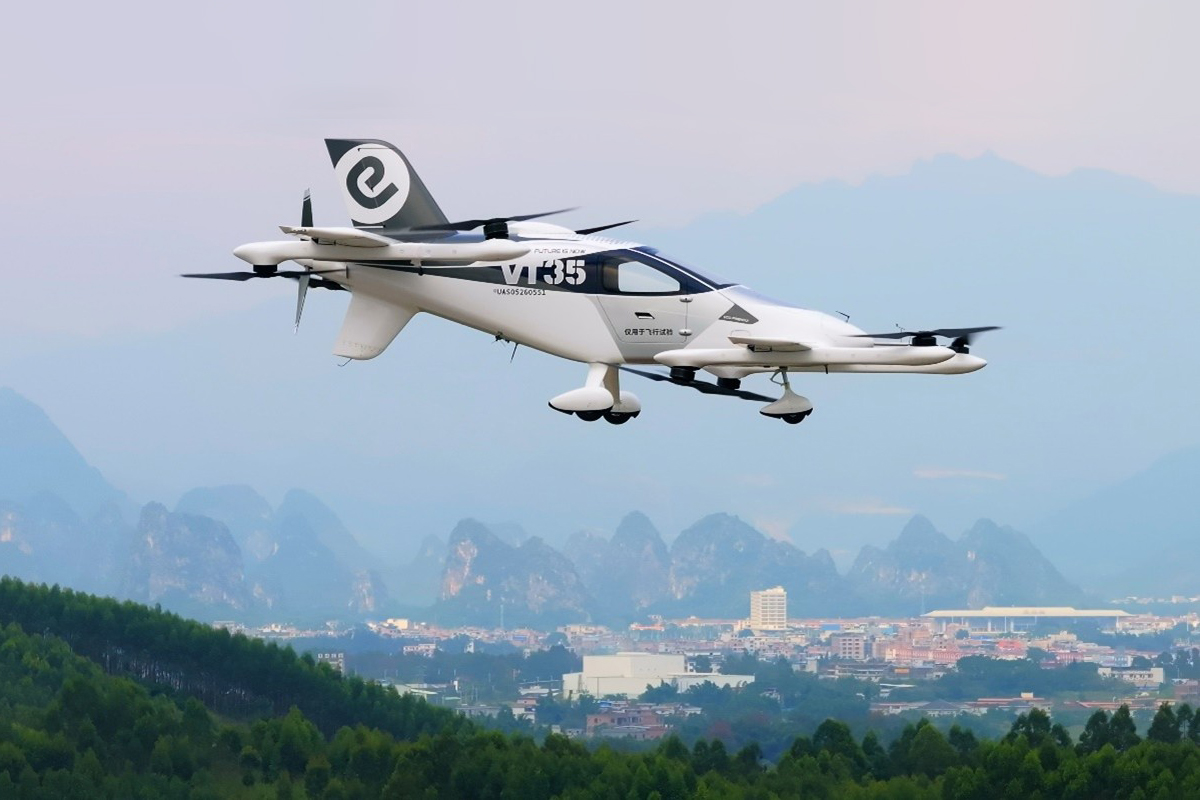
(Photo credit: EHang)
VT35 (production model)
EHang
Guangzhou City, Guangdong Province, China
www.ehang.com
The information provided here is as accurate as possible; however, eVTOL information from China is sometimes sparse, incomplete or conflicting. China is promoting what they call the "low-altitude economy" — a new push for general aviation — which includes both crewed and uncrewed passenger and air cargo eVTOL aircraft.
EHang was founded in December 2014 by Huazhi Hu, Chairman and Chief Executive Officer and Derrick Yifang Xiong, Director and Chief Marketing Officer. EHang is an autonomous aerial vehicle technology platform company based in China and is pioneering the future of all-electric aerial transportation through multiple proprietary products and services. The company designs and manufactures electric vertical takeoff and landing (eVTOL) passenger and cargo aircraft for advanced air mobility (AAM). The mission of EHang is to provide safe, autonomous and eco-friendly air mobility for everyone.
Selected EHang achievements
- December 2014: Company founded in China
- July 2018: EH216-S eVTOL aircraft (the current production model) had made over 1,000 manned flights
- October 2023: Type Certificate (CAAC)
- April 2024: Production Certificate
- March 2025: Air Operator Certificates
- March 2025: Commercial flights begin
EHang's primary products and services
- eVTOL passenger transportation, logistics and urban high-rise firefighting
- Smart city management
- New-generation infrastructure for advanced air mobility (AAM)
- Command and Control Center (For passenger, cargo and drone services.)
- Multiple commercial eVTOL drone services (Such as aerial mapping; forest fire surveillance, inspection and reporting; public safety surveillance; traffic management; 3 dimension modeling; news reporting and more.)
- eVTOL Aerial Media (Nighttime light shows in the sky created by using thousands of drones)
VT35 passenger eVTOL aircraft (production model)
The VT35 is a futuristic autonomous long-range two passenger eVTOL aircraft production model. The aircraft has intelligent interactive entertainment, a mobile office, a spacious and comfortable cabin, air conditioning, lighting controls and storage for luggage.
The safety specifications of the aircraft are many. Have autonomous worry-free long-range air travel that includes multiple redundancies across flight control, power and avionics systems to prevent single-point failures. These comprehensive safeguards also offer real-time obstacle avoidance for complete safety for all phases of flight. The aircraft has smaller dimensions than general aviation aircraft and can land in smaller types of landing areas such as vertiports or parking lots (in urban or rural areas) with precise takeoff and landing capability.
With its tandem wing layout with multiple control surfaces, the aircraft can handle high-altitude winds, low-altitude turbulence and complex airflow. The aircraft does all these things with zero carbon emissions and low noise, enabling green mobility to coexist with cities.
The cruise speed of the aircraft is 216 km/h (134 mph), has a range of 200 km (124 m) and has a flight time of 60 minutes. The aircraft has nine propellers, nine electric motors and is powered by battery packs. The aircraft has tandem wings, each wing has four VTOL-only propellers and has a pusher propeller in the rear of the fuselage. The fuselage is made from carbon fiber composite to give the aircraft a high strength to low weight ratio. The aircraft has fixed tricycle wheeled landing gear.
EHang making eVTOL revenue service history and Western competitor comparison
EHang has quietly made world history with the EH216-S being the first certified autonomous passenger eVTOL aircraft in commercial service (which started in March 2025) in multiple cities. The EH216-S aircraft has been certified flight worthy by the Civil Aviation Administration of China (CAAC). The company is currently providing autonomous pilotless sightseeing and air taxi flights in Guangzhou, Hefei, Shenzhen and Wenchen, China.
In addition, EHang is aggressively working to expand their passenger eVTOL commercial flight service beyond China. The company has made demonstration flights in Bangkok, Thailand in November 2025 and had trial flights in Saudi Arabia in November 2024. The company is working on multiple partnerships throughout Southeast Asia and other countries that are more open to Chinese certified aircraft before attempting the more complex FAA and EASA certification processes.
EHang chose autonomous piloting first while Western competitors chose piloted flights first, then will progress to autonomous piloting. As of 2025, EHang's Western competitors have still not achieved revenue flights with their passenger eVTOL aircraft.
EHang is at least two years or more ahead of its Western competitors. What does this mean? EHang is not only collecting revenue, the company is refining its autonomous flight systems with real-world flights, accumulating operational data, gaining years of employee experience and skills, have optimized their production line process and are building maintenance expertise.
Specifications:
- Aircraft type: Passenger eVTOL aircraft (production model)
- Piloting: Remote piloting using EHang's Centralized Command and Fleet Managment.
- Capacity: 2 passengers
- Cruise speed: 216 km/h (134 mph), this is the economic cruising speed
- Range: 200 km (124 m), this is the full load range of the aircraft
- Flight time: 60 minutes
- Maximum payload weight: 200 kg (441 lb)
- Propellers: 9 propellers. 1 pusher propeller for forward flight. 8 VTOL-only propellers.
- Electric motors: 9 electric motors
- Power source: Battery packs
- Fuselage: Carbon fiber composite
- Length: 8.26 m (27 ft)
- Wingspan (maximum width): 8.16 m (26.7 ft)
- Height: 3.09 m (10.14 ft)
- Windows: Typical general aviation windows
- Wings: Tandem wings with winglets
- Tail: 1 vertical stabilizer
- Landing gear: Fixed tricycle wheeled landing gear
- Safety features: Distributed Electric Propulsion (DEP) uses multiple propellers or electric ducted fans, each powered by electric motors, to increase safety through redundancy. If one or more components fail, the remaining ones can still ensure a safe landing. There are also redundancies of critical components in the flight control, power and avionics systems preventing single-point failures, providing safety through redundancy. The aircraft has no moving surfaces or tilting parts when transitioning from vertical to forward flight and the reverse (except wing flaps and a vertical stabilizer flap) which increases safety by reducing complexity.
Related Aircraft:
- EHang 116 (prototype)
- EHang 184 (defunct)
- EHang EH216-F (production model)
- EHang EH216-L (production model)
- EHang EH216-S (production model)
- EHang VT-25 (concept design)
- EHang VT-30 (prototype)
Company Insights:
Resources:
- EHang website
- EHang Urban Air Mobility Information
- EHang Facebook
- EHang Twitter
- EHang Instagram
- EHang YouTube
- Article: The Demand for On-Demand Mobility, Vertiflite, Jan. 2017
- Article: eHang's pilotless eVTOL air taxi takes flight with 125-mile range, New Atlas, Oct. 13, 2025
- Video: The EHang VT35 – a next-generation long-range pilotless passenger eVTOL, EHang, Oct. 13, 2025
- Article: EHang unveils VT35 eVTOL, Asian Aviation, Oct. 16, 2025
- Article: EHang Makes History: The World's First Paid Commercial Air Taxi Flights, eVTOL.Travel, Feb. 23, 2026

Recent Pages
- SMD Shenzhen Smart Drone UAV Bullet (production model)
- DreamFly Aerotech DF3000 Youlong (prototype)
- aeroG Aviation AG-8 (concept design)
- NASA Tiltwing-Two (illustration)
- CoolFly Urban 4 (concept design)
- CoolFly Standing Flight Platform (prototype)
- CoolFly Urban 3 (prototype)
- CoolFly Urban 2 (concept design)
- CoolFly Urban (production model)
- CoolFly Dream ST (production model)