Embry-Riddle PAV-ER (concept design)
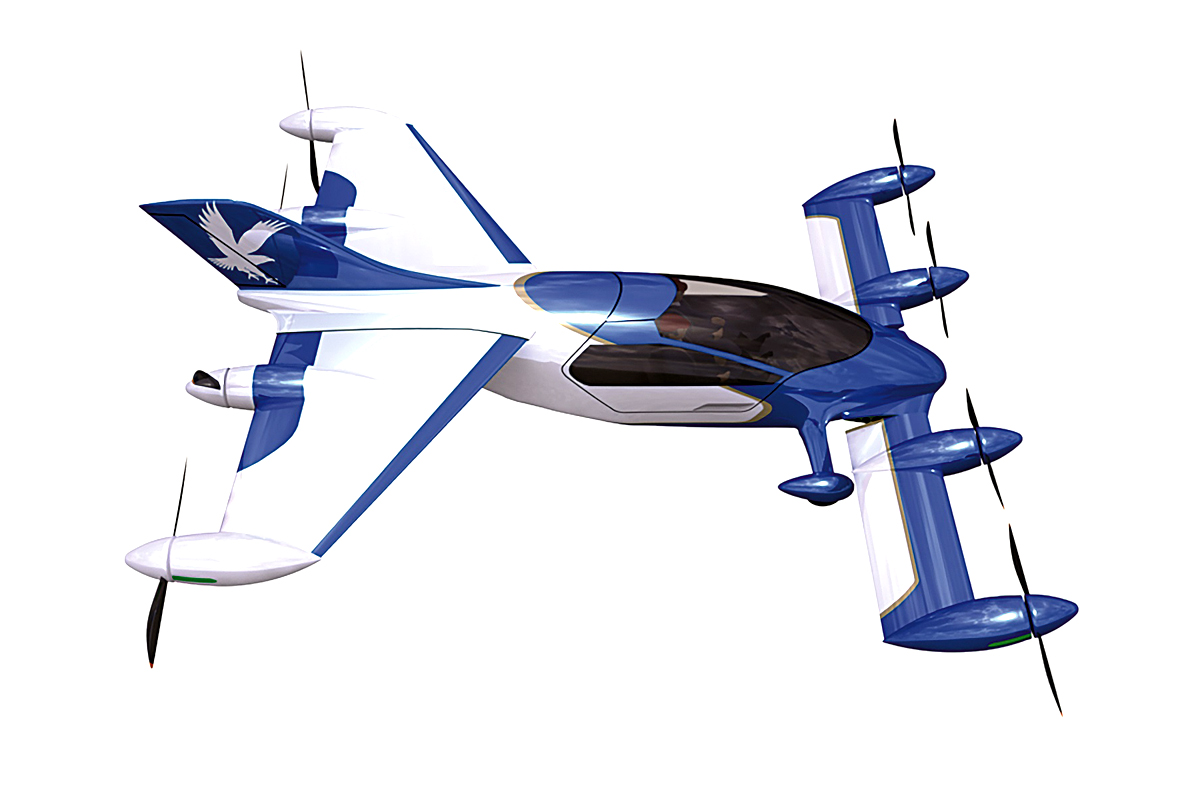
(Image credit: Eagle Flight Research Center, Embry-Riddle Aeronautical University)
PAV-ER (concept design)
Eagle Flight Research Center
Embry-Riddle Aeronautical University
Daytona Beach, Florida, United States of America
www.erau.edu
Founded in 1926, Embry–Riddle Aeronautical University is a private university based in Daytona Beach, Florida, and in Prescott, Arizona, United States. The university has courses in aviation, aerospace, applied sciences, business, computers & technology, engineering, and security, intelligence & safety and more. Embry-Riddle has numerous online programs and academic programs offered online at many satellite locations. The PAV-ER is an electric vertical takeoff and landing (eVTOL) technology demonstrator to help propel the nascent advanced air mobility (AAM) industry.
"PAV-ER hardware and software mimic and counter servo failures, motor failures and other malfunctions, according to principal investigator Dr. Kyle Collins (Embry-Riddle Aeronautical University), It will be a fault-tolerant control system." "The air-taxi-sized testbed can also help formulate scaling laws for bigger non-traditional eVTOL aircraft," according to Dr. Pat Anderson (Embry-Riddle Aeronautical University). "The research center is looking for external funding and plans to evolve the testbed, notionally adding an aerodynamic shell, composite frame and hybrid electric propulsion," said Anderson. These excerpts were taken from the article, Controlling Interest, by the Vertical Flight Society.
Anderson said. "This begins to align with airline-type safety requirements, which makes the vehicle safer than standard helicopters." This quote from the article PAV-ER: New Personal Air Vehicle built in the University’s Eagle Flight Research Center Features Hybrid Propulsion, Rotor Blades, Embry-Riddle Aeronautical University, Sept. 16, 2020.
PAV-ER (Personal Air Vehicle–Embry-Riddle) long-range passenger hybrid-electric VTOL vectored thrust aircraft (concept design)
The PAV-ER (Personal Air Vehicle–Embry-Riddle) is a sleek and modern looking fly-by-wire long-range two passenger hybrid-electric VTOL vectored thrust aircraft. The aircraft will be flown by a pilot or possibly by an artificial intelligent pilot. The interior of the aircraft will be modern and comfortable and will also have space for luggage behind the passenger seats. The aviation technology will be user friendly will allow the pilot or passengers to direct the aircraft to a particular destination, make a course correction to a new destination and make emergency landing decisions. Passengers will have an in-flight information display showing position, route, cities below, speed, ground speed, outside air temperature, altitude, distance to destination and estimated time of arrival.
The cockpit canopy opens from the front and tilts backward allowing both passengers to enter or exit the aircraft at the same time. The aircraft has eight tilt-wing propellers, eight electric motors and is powered by a hybrid-electric power source. The aircraft has two tandem wings and each wing section can tilt vertically up or tilt vertically down. Each of the four wing sections can independently tilt allowing for smooth course corrections and to respond to normal windy conditions and gusty wind conditions. The fuselage is made from carbon fiber composite to give the aircraft a high strength to low weight ratio. The aircraft has fixed tricycle wheeled landing gear. The aircraft will be able to fly with one propeller failure. The status of the project is unknown.
Specifications:
- Aircraft type: Passenger hybrid-electric VTOL aircraft (concept design)
- Piloting: Pilot or artificial intelligent pilot using fly-by-wire controls
- Capacity: 2 passengers (Or 1 pilot and 1 passenger)
- Cruise speed: Unknown
- Maximum payload weight: ~450 lb (~204 kg)
- Propellers: 8 propellers on tilt-wings (Each wing section can tilt up or down, there are 4 wing sections that tilt)
- Electric motors: 8 electric motors
- Power source: Hybrid-electric power source
- Fuselage: Carbon fiber composite
- Window: Canopy over cockpit with side windows
- Wings: Tandem wings
- Tail: 1 vertical stabilizer
- Landing gear: Fixed tricycle wheeled landing gear.
- Safety features: Distributed Electric Propulsion (DEP) uses multiple propellers or electric ducted fans, each powered by electric motors, to increase safety through redundancy. If one or more components fail, the remaining ones can still ensure a safe landing. There are also redundancies of critical components in the sub-systems of the aircraft providing safety through redundancy. Having multiple redundant systems on any aircraft decreases having any single point of failure.
Related Aircraft:
- Embry-Riddle PAV-ER (technology demonstrator)
- Embry-Riddle Talon Lift Talon (concept design)
Resources:
- Embry-Riddle Aeronautical University website
- Eagle Flight Research Center, Embry-Riddle Aeronautical University website
- Eagle Flight Research Center, Embry-Riddle Aeronautical University Instagram
Eagle Flight Research Center, Embry-Riddle Aeronautical University LinkedIn - Article/Video: The Flying Car Becomes a Reality, Embry-Riddle Aeronautical University, Sept. 6, 2017
- Article: Embry‑Riddle Works to Advance Sustainable Environmentally Friendly Urban Air Mobility Vehicles, Embry-Riddle Aeronautical University, Aug. 17, 2020
- Article: PAV-ER: New Personal Air Vehicle built in the University’s Eagle Flight Research Center Features Hybrid Propulsion, Rotor Blades, Embry-Riddle Aeronautical University, Sept. 16, 2020
- Video: Personal Air Vehicle Development (PAV-ER), Embry-Riddle Aeronautical University, 2021
- Article: Richard Anderson, Vertipedia by the Vertical Flight Society, Vertiflite, Jan/Feb 2021
- Article: Controlling Interest, Vertiflite, March/April 2021
- Video: PERSONAL AIR VEHICLE by EMBRY-RIDDLE | URBAN AIR MOBILITY, Alan Makoso, Apr. 19, 2021

Recent Pages
- DreamFly Aerotech DF3000 Youlong (prototype)
- aeroG Aviation AG-8 (concept design)
- NASA Tiltwing-Two (illustration)
- CoolFly Urban 4 (concept design)
- CoolFly Standing Flight Platform (prototype)
- CoolFly Urban 3 (prototype)
- CoolFly Urban 2 (concept design)
- CoolFly Urban (production model)
- CoolFly Dream ST (production model)
- CoolFly Dream Pro (production model)