Penn State University Soteria Swift (concept design)
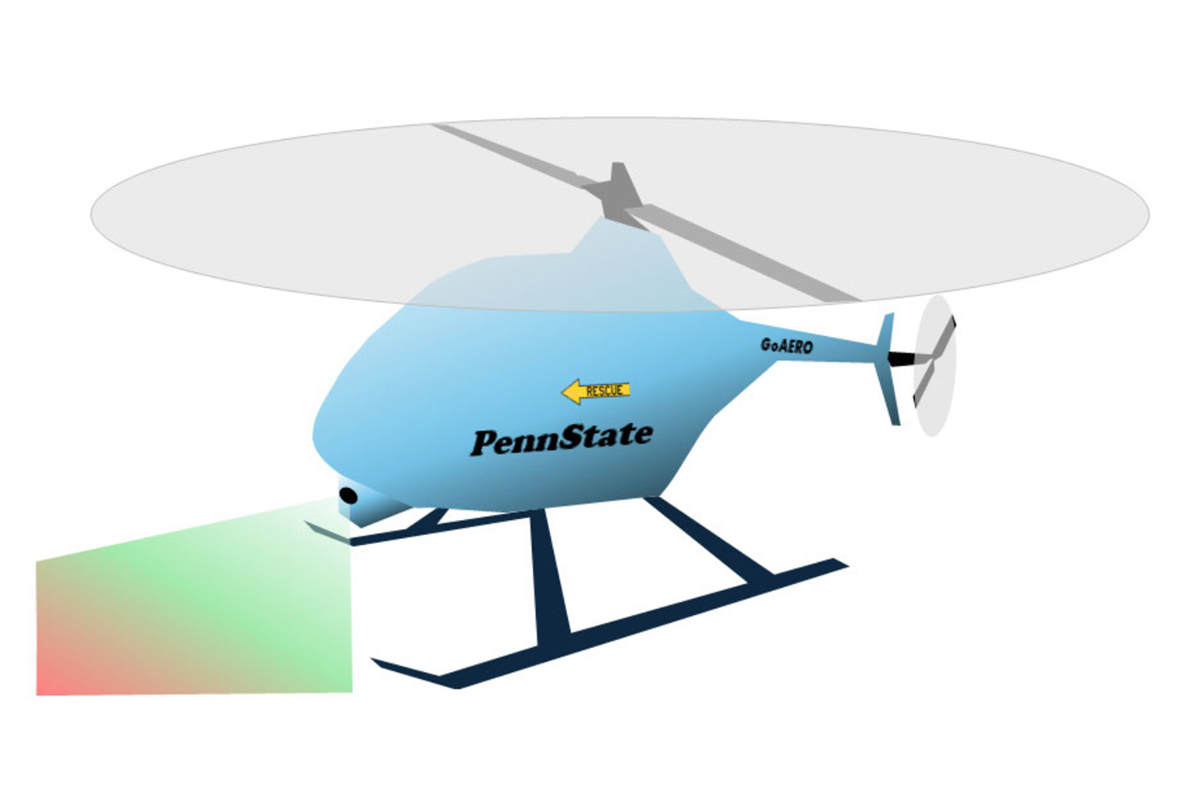
(Image credit: Penn State University Soteria Swift Team )
Soteria Swift (concept design)
Penn State University
University Park, Pennsylvania, USA
Website Unknown
Undergraduate, master students and doctoral students at Penn State University, University Park, Pennsylvania, USA have formed a team for the GoAERO competition, to design and build an autonomous passenger rescue electric helicopter (can also be called an electric vertical takeoff and landing or eVTOL rotorcraft). The name of the team is officially, "Penn State University".
The Penn State University team is a GoAERO Stage 1 and Stage 2 award winners in 2025 and was one of 14 NASA University Innovation Award winners. The team proposes their specific aircraft is needed for multiple types public emergency missions where traditional rescue teams can't access the search zone with current rescue team technology. The team's electric helicopter is another example of electric rotorcraft being designed that will help to further the nascent advanced air mobility (AAM) industry.
Soteria Swift autonomous heavy-lift passenger rescue electric helicopter (concept design)
The Soteria Swift is an autonomous heavy-lift passenger rescue electric helicopter. The team's rotorcraft has been designed to be easy to deploy and easy to operate in unknown environments. The helicopter has an on-board collision avoidance protection system and a landing a zone selection system that uses minimal onboard or remote inputs.
The rotorcraft will have one main rotorblade, one tail rotor, two electric motors and is powered by battery packs. The fuselage is made from carbon fiber composite to give the aircraft a high strength to low weight ratio. The helicopter has fixed skid landing gear.
In addition, the team is designing the electric helicopter to have faster response times, larger payload capacities and relay ground conditions to command personnel. Another goal of the helicopter is to be able to fly while operating in smoke and low visibility areas while flying precisely to rescue areas. All of these design features with the ultimate mission of making sure rescue teams and patients are kept safe during the entire rescue operation.
About the GoAERO Prize Competition
The GoAERO Prize, sponsored by Boeing, is a three year competition (2024-2027) offering over $2 million USD in prizes that challenges engineers worldwide to create portable, versatile and autonomy-enabled Emergency Response Aircraft that address not only everyday medical emergencies but also to be used in natural disasters, humanitarian emergencies and climate crises worldwide. Each team designs and builds autonomous Emergency Response aircraft capable of delivering a first responder, medical equipment and supplies and ultimately evacuating victims in need to a rescue ambulance or hospital.
More than 150 teams from around the globe are competing for the GoAero prizes. The GoFly and GoAERO prizes were developed by Boeing and other organizations to help the nascent advanced air mobility (AAM) industry move forward.
Specifications:
- Aircraft type: Autonomous heavy-lift passenger rescue electric helicopter (concept design)
- Piloting: Autonomous
- Capacity: 1 passenger, medical equipment, medicine or other cargo (or possibly 2 people with medical equipment and medicine)
- Cruise speed: Unknown
- Maximum payload weight: ~300 lb (136 kg)
- Rotorblades: 1 main rotor blade, 1 tail rotor
- Electric motors: 2 electric motors
- Power source: Battery packs
- Fuselage: Carbon fiber composite
- Windows: Unknown
- Landing gear: Fixed skid landing gear
- Safety features: There are also redundancies of critical components in the sub-systems of the aircraft providing safety through redundancy. Having multiple redundant systems on any aircraft decreases having any single point of failure. Using electric motors for the main rotorblade and tail rotor increases the safety of the helicopter due to less mechanical linkages that could fail and because well built electric motors are less complex and have a longer service life than conventional engines.
Resources:
- Team Penn State University Soteria Swift website is unknown
- Article: GoAERO Launches $2M+ VTOL Challenge, Electric VTOL News, Feb. 12, 2024
- Article: Stage 1 Winners, GoAERO, Feb. 2025
- Article: GoAERO Announces Eleven Stage 1 Winners, Aero News Network, Feb. 16, 2025
- Article: GoAERO Global Emergency Response Flyer Competition Announces $500,000 of Awards to Innovators Worldwide with Support from Boeing, NASA, RTX, and Honeywell, GoAERO, Feb. 18, 2025
- Article: GoAERO Awards $500,000 to Stage 1 Teams, Vertiflite Magazine, Mar/Apr 2025
- Article: GoAERO Competition Promotes Creation of Automatic Lifesavers, Flying Magazine, Nov. 17, 2025
- Article: Stage 2 Winners, GoAERO, Dec. 2025
- Article: Building the Future: GoAERO Announces Stage 2 Prototype Winners, GoAERO, Dec. 3, 2025
- Article: GoAERO Global Emergency Response Flyer Competition Announces 8 Stage 2 Prototype Winning Teams, GoAERO, Dec. 3, 2025
- Article: GoAERO Announces Stage 2 Prototype Winning Teams, Inspiring Creation of Emergency Response Flyers, eVTOL Insights, Dec. 4, 2025
- Article: First responders: Meet the self-flying aircraft built to take rescue aviation beyond helicopters, Aerospace Global News, Dec. 15, 2025

Recent Pages
- DreamFly Aerotech DF3000 Youlong (prototype)
- aeroG Aviation AG-8 (concept design)
- NASA Tiltwing-Two (illustration)
- CoolFly Urban 4 (concept design)
- CoolFly Standing Flight Platform (prototype)
- CoolFly Urban 3 (prototype)
- CoolFly Urban 2 (concept design)
- CoolFly Urban (production model)
- CoolFly Dream ST (production model)
- CoolFly Dream Pro (production model)