California State Polytechnic University Pegasus (concept design)
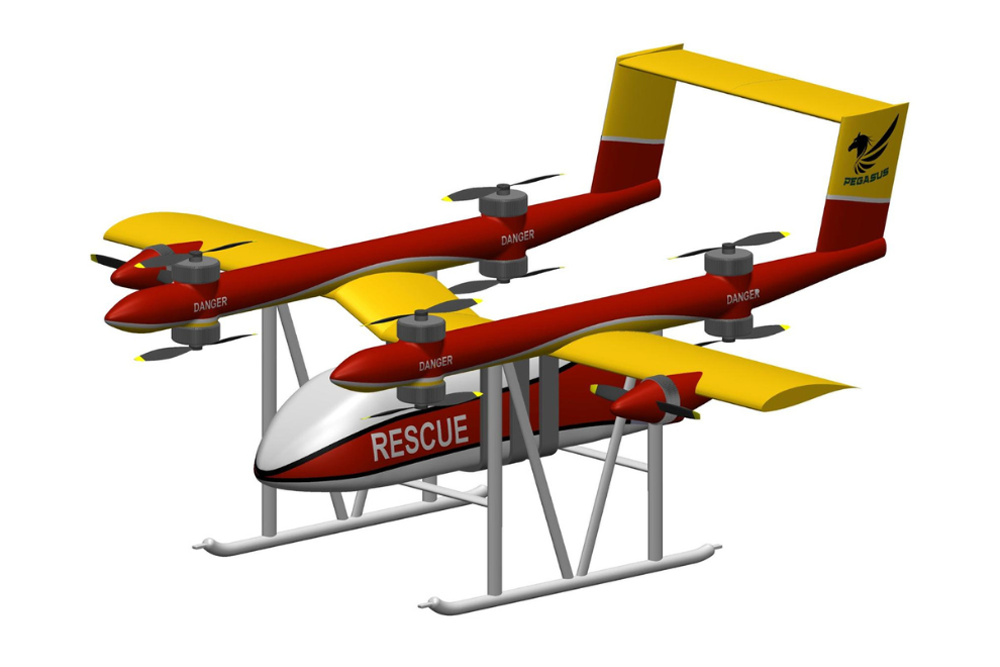
(Image credit: CPP.AERO Pegasus)
Pegasus (concept design)
CPP.AERO Pegasus (team name)
Aerospace Engineering Department
California State Polytechnic University
Pomona, California, USA
www.cpp.edu/engineering/aro
For the GoAERO competition, a team was formed by students from the Aerospace Engineering Department at the California State Polytechnic in Pomona, California, USA. CPP.AERO Pegasus is the team name. The name of their aircraft is Pegasus. The goal of the team is to design and build a working autonomous compact low-cost rescue electric vertical takeoff and landing (eVTOL) aircraft. The team won the GoAERO Stage 1 award in 2025 and was one of 14 NASA University Innovation Award winners.
The team lead is Mark Gonda and the team members include Rudy Barragan, Mason Chin, Ian Chu, Nick D'ambrosio, Vahagan Hayrapetyan, Daniel Klein, Manuel Koukourian, Conner Mustar, David Tu and Jose Vasquez Rosales. All are undergraduates in the Aerospace Engineering Department, where they are enrolled in air vehicle design courses. Participation in GoAERO is part of the students' senior project to design and create an actual flying vehicle.
Due to recent natural disasters (2023-2025) in California, team members see a need to have a new type of effective but low-cost aircraft that can rescue people in need of emergency medical care or in need of food or water during a natural disaster.
Pegasus passenger and air cargo rescue eVTOL aircraft (concept design)
The Pegasus is a lift+cruise autonomous passenger and air cargo rescue eVTOL aircraft. Looking at the aircraft, it uses a simplified designed to keep costs down while having maximum utility for rescue operations. The aircraft can also be used to airdrop food, water, medical supplies and other needed items to people during natural disasters.
The aircraft has two tractor propellers, eight stacked VTOL-only propellers and is powered by battery packs. The aircraft has one high main wing and has one high boom tail. The fuselage is made from carbon fiber composite to give the aircraft a high strength to low weight ratio. The landing gear is fixed skid landing gear allowing the aircraft to land on prepared or unprepared landing areas. Using a simplified design reduces complexity, increases the safety and reduces maintenance costs.
The team has stated they are developing a 35% subscale prototype which will help them test materials, electronics and real-world test flights which will ultimately help them design and manufacture a full-scale prototype.
About the GoAERO Prize Competition
The GoAERO Prize, sponsored by Boeing, is a three year competition (2024-2027) offering over $2 million USD in prizes that challenges engineers worldwide to create portable, versatile and autonomy-enabled Emergency Response Aircraft that address not only everyday medical emergencies but also to be used in natural disasters, humanitarian emergencies and climate crises worldwide. Each team designs and builds autonomous Emergency Response aircraft capable of delivering a first responder, medical equipment and supplies and ultimately evacuating victims in need to a rescue ambulance or hospital.
More than 150 teams from around the globe are competing for the GoAero prizes. The GoFly and GoAERO prizes were developed by Boeing and other organizations to help the nascent advanced air mobility (AAM) industry move forward.
Specifications:
- Aircraft type: Passenger and air cargo rescue eVTOL aircraft (concept design)
- Piloting: Autonomous
- Capacity: 1 patient and air cargo
- Cruise speed: ~100 mph (~161 km/h)
- Maximum payload weight: ~300 lb (~136 kg)
- Propellers: 10 propellers (2 tractor propellers, 8 VTOL-only propellers)
- Electric motors: 10 electric motors
- Power source: Battery packs
- Fuselage: Carbon fiber composite
- Wings: 1 high main wing
- Tail: 1 high boom tail
- Landing gear: Fixed skid landing gear
- Safety features: Distributed Electric Propulsion (DEP) uses multiple propellers or electric ducted fans, each powered by electric motors, to increase safety through redundancy. If one or more components fail, the remaining ones can still ensure a safe landing. There are also redundancies of critical components in the sub-systems of the aircraft providing safety through redundancy. Having multiple redundant systems on any aircraft decreases having any single point of failure. The aircraft has no moving surfaces or tilting parts when transitioning from vertical to forward flight and the reverse which increases safety by reducing complexity.
Resources:
- California State Polytechnic University website
- California State Polytechnic University Facebook
- California State Polytechnic University Instagram
- California State Polytechnic University YouTube
- California State Polytechnic University X (Formerly Twitter)
- California State Polytechnic University LinkedIn
- Article: GoAERO Launches $2M+ VTOL Challenge, Electric VTOL News, Feb. 12, 2024
- Article: Stage 1 Winners, GoAero, Feb. 2025
- Article: GoAERO Global Emergency Response Flyer Competition Announces $500,000 of Awards to Innovators Worldwide with Support from Boeing, NASA, RTX, and Honeywell, GoAero, Feb. 18, 2025
- Article: GoAERO Awards $500,000 to Stage 1 Teams, Vertiflite Magazine, Mar/Apr 2025
- Article: Meet the Teams: Team Pegasus of Cal Poly-Pomona, GoAERO, May 29, 2025
- Article: GoAERO Competition Promotes Creation of Automatic Lifesavers, Flying Magazine, Nov. 17, 2025

Recent Pages
- DreamFly Aerotech DF3000 Youlong (prototype)
- aeroG Aviation AG-8 (concept design)
- NASA Tiltwing-Two (illustration)
- CoolFly Urban 4 (concept design)
- CoolFly Standing Flight Platform (prototype)
- CoolFly Urban 3 (prototype)
- CoolFly Urban 2 (concept design)
- CoolFly Urban (production model)
- CoolFly Dream ST (production model)
- CoolFly Dream Pro (production model)