Doroni Aerospace H1-X (mockup)
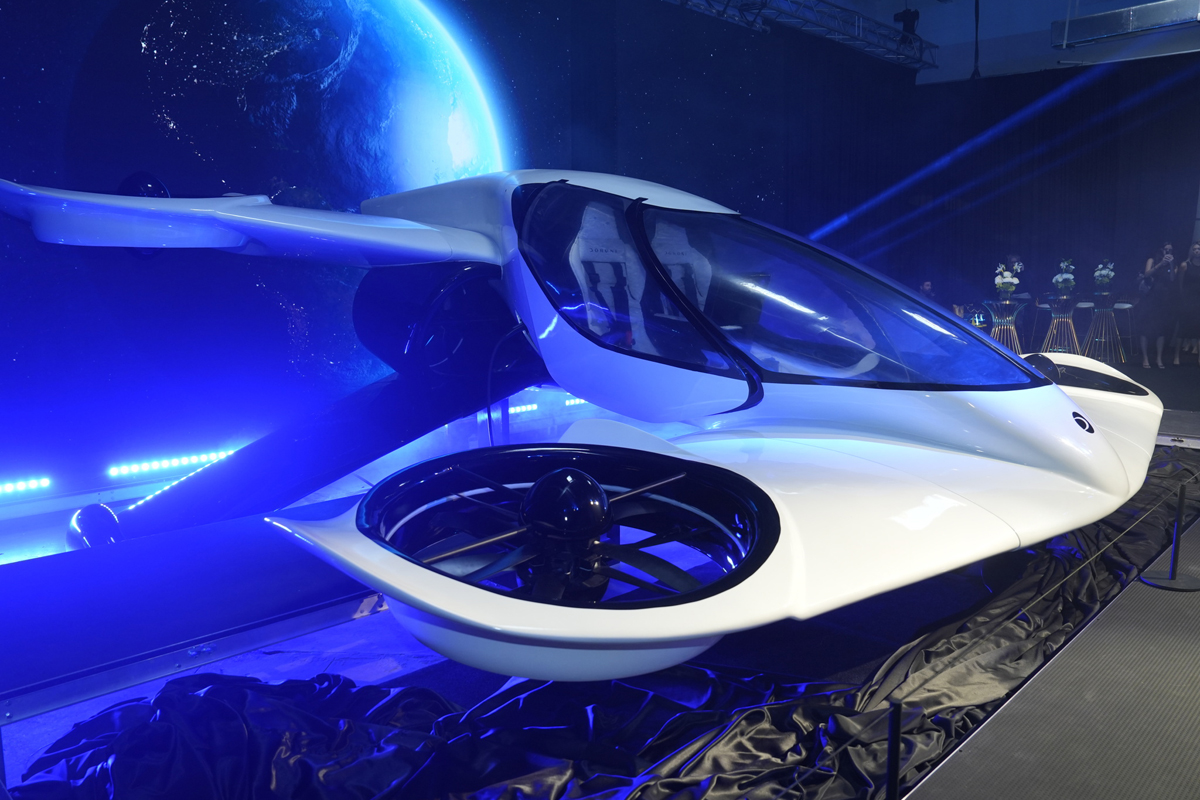
(Photo credit: Doroni Aerospace)
H1-X (mockup)
Doroni Aerospace
Fort Lauderdale, Florida, USA
www.doroni.io
Founder and CEO Doron Merdinger started the Doroni company in 2016 because he believes the technology is now here to make the future of traveling clean and wheelless. Merdinger from the start, wants his electric vertical takeoff and landing (eVTOL) aircraft to be available to purchase by the consumer, businesses and governments. "Why limit the future?," says Merdinger, "Allow everyone to buy these (aircraft)." As of March 2024, Doroni has raised close to $6 million (USA) with over 430 pre-order requests. In February 2025, the company received a $30 million (USD) investment from Innovation Wings Industries (IWI), operating as Kingdom Aero Industries (KAI) located in Saudi Arabia.
Passenger Safety and Aircraft Durability
The two most important goals for the company is passenger safety and durability of the aircraft. Safety is achieved by having multiple redundancies built into the aircraft, from multiple propellers and avionics, various anti-collision sensors and to a whole aircraft ballistic parachute. While today's conventional aircraft are overly complicated, durability is achieved by greatly reducing the amount of moving parts, keeping the aircraft simplified, using a modular design for easier maintenance and using off-the-shelf components.
Additional Goals
Additional and important goals for the aircraft will be its ability to function in a variety of climates and windy conditions, to make the aircraft very easy to fly (simpler than driving a car), provide fast advanced air mobility (AAM), make the aircraft affordable to everyone and have no exhaust pollution. The H1 eVTOL aircraft will have multiple ways for controlling the aircraft including piloting, remote controlled piloting and further into the future, using Artificial Intelligence (AI) for autonomous flight.
Clean Sheet Design
Instead of using a helicopter or airplane fuselage and then add multiple small electrically powered propellers, the company decided to start with a clean sheet design for their aircraft. The Doroni H1 eVTOL aircraft is not a helicopter or an airplane, it is a new type of aircraft. Doroni has taken the best of all aircraft, designed the aircraft to be as least complicated as possible which increases the safety of the aircraft, reduces with weight of the aircraft, reduces with cost of manufacturing the aircraft, reduces the price of the aircraft and reduces maintenance costs for the aircraft.
Piloting the Aircraft
The company states their aircraft will be easy to operate and to fly it, the pilot will only need a simple piloting certification which requires a driver's license and a student pilot certificate for Light Sport Aircraft. Its a smart vehicle with advanced electronics such as Wi-Fi enabled, GPS, laser, cameras, barometer and accelerometer. Doroni has estimated they will be test flying the full scale H1 aircraft in 2024. The aircraft will have Soul.AI as a digital co-pilot. AI piloting will include threat detection, critical alerts, anti-collision, real-time weather conditions, airspace restrictions, charging station availability, voice control and remote diagnostics.
Award Winning Design
On June 10, 2021, Space Florida and the Florida Venture Forum announced that Doroni won the 2nd Place prize of $15,000.00 USD at the all-virtual sixth annual 2021 Aerospace Innovation and Tech Forum. Twenty presenting companies were selected from a pool of more than 84+ applicants by a committee of active Florida venture capital investors. Space Florida provided the Accelerating Innovation prize money totaling $100,000.00 USD.
H1-X full-scale passenger eVTOL aircraft (mockup)
The H1-X is a full-scale two passenger eVTOL showroom engineering model aircraft. The aircraft mockup is a detailed representation of the H1-X showing exterior and interior details. The mockup was unveiled to the public at the company's headquarters in Fort Lauderdale, Florida, USA on March 27, 2026. Piloting the aircraft will require a light sport aircraft certificate and will have an onboard Soul.AI digital co-pilot.
As of March 2026, planned production model has an expected cruise speed of 95 mph (153 km/h), has an anticipated cruise altitude in the range of 500-1,500 ft (152-457 m) and has a calculated range of 100 m (161 km). The aircraft has eight VTOL-only stationary propellers, has two electric ducted fans (EDF) for forward flight, has 10 electric motors and is powered by battery packs. The charge time for the aircraft is projected to be 25 minutes.
The H1-X has a canopy over the cockpit with gull-wing doors. The aircraft has tandem wings. The empty weight of the aircraft is predicted at 1,850 lb (839 kg), has a maximum payload weight measured at 500 lb (227 kg) and has a maximum takeoff weight targeted at 2,350 lb (1,066 kg). The fuselage is made from carbon fiber composite to give the aircraft a high strength to low weight ratio. The aircraft has fixed tricycle wheeled landing gear.
Anticipated Serial Production
As of March 2026, the company expects initial deliveries of the H1-X passenger eVTOL aircraft in 2028.
Specifications:
- Aircraft type: Full-scale passenger eVTOL aircraft (planned production model specifications)
- Piloting: Pilot with a light sport aircraft certificate and a Soul.AI digital co-pilot
- Capacity: 2 passengers
- Cruise speed: 95 mph (153 km/h)
- Maximum cruise speed: 120 mph (193 km/h)
- Range: 100 m (161 km)
- Cruise altitude: 500-1,500 ft (152-457 m)
- Empty weight: 1,850 lb (839 kg)
- Maximum payload weight: 500 lb (227 kg)
- Maximum takeoff weight: 2,350 lb (1,066 kg)
- Propellers: 8 VTOL-only ducted propellers, 2 rear electric ducted fans (EDF) for forward flight
- Electric motors: 10 electric motors
- Power source: Battery packs
- Charge Time: 25 minutes
- Fuselage: Carbon fiber composite
- Width: 230 in (5.842 m)
- Length: 220 in (5.588 m)
- Window: Canopy over cockpit
- Wings: Tandem wings
- Landing gear: Fixed tricycle wheeled landing gear.
- Safety features: Distributed Electric Propulsion (DEP) means having multiple propellers (or electric ducted fans) and multiple electric motors on an aircraft so if one or more propellers (or electric ducted fans) or some electric motors fail, the other working propellers (or electric ducted fans) and electric motors can safely land the aircraft. DEP provides safety through redundancy for its passengers or cargo. There are also redundancies of critical components in the sub-systems of the aircraft providing safety through redundancy for its passengers or cargo. Having multiple redundant systems on any aircraft decreases having any single point of failure. There is also a whole aircraft emergency ballistic parachute in case of an unexpected inflight emergency.
Related Aircraft:
- Doroni Aerospace Carbon One (concept design)
- Doroni Aerospace H1 (concept design)
- Doroni Aerospace H1 (technology demonstrator)
- Doroni Aerospace H1-X (concept design)
- Doroni Aerospace H1-X Cargo (concept design)
- Doroni Aerospace H1-XE EMS (concept design)
- Doroni Aerospace H1-XM Military (concept design)
- Doroni Aerospace H1-XP Police (concept design)
- Doroni Aerospace X8 (concept design)
- Doroni Aerospace Yellowjacket Y6 (prototype)
Company Insights:
Resources:
- Doroni Aerospace website
- Doroni Aerospace Facebook
- Doroni Aerospace X (Formerly Twitter)
- Doroni Aerospace YouTube Channel
- Doroni Aerospace Instagram
- Doroni Aerospace LinkedIn
- Article: Doroni Aerospace publicly launches its H1-X personal eVTOL, Urban Air Mobility, Apr. 1, 2026
- Article: Doroni Aerospace Unveils the H1-X 'Flying Car' at Soul of the Sky Event, Yahoo! Finance, Apr. 7, 2026
- Article: Personal eVTOL developer Doroni targets 2028 for customer deliveries, Aerospace Testing International, Apr. 10, 2026

Recent Pages
- aeroG Aviation AG-8 (concept design)
- NASA Skylark (concept design)
- CoolFly Urban 4 (concept design)
- CoolFly Standing Flight Platform (prototype)
- CoolFly Urban 3 (prototype)
- CoolFly Urban 2 (concept design)
- CoolFly Urban (production model)
- CoolFly Dream ST (production model)
- CoolFly Dream Pro (production model)
- CoolFly Dream (prototype)