NASA Skylark (concept design)
(Image credit: NASA)
Skylark (concept design)
NASA Ames Research Center
Moffett Field, California, USA
www.nasa.gov/ames
Established in 1958, the National Aeronautics and Space Administration (NASA) is an independent agency of the U.S. federal government responsible for the civil space program, aeronautics research and space research. NASA is headquartered in Washington, D.C. and has 10 major field centers. NASA has made space ships, explored space, the moon, launched satellites, gathered data about Earth from space, made the Skylab Space Station, explored Mars, studied our solar system using space probes and more.
NASA's Distributed Electric Propulsion (DEP) research
NASA started researching distributed electric propulsion (DEP) electric vertical takeoff and landing (eVTOL) and hybrid-electric VTOL aircraft in 2009. DEP was introduced to the world in November 2009 when Mark Moore, while still at NASA, unveiled the Puffin, a personal an all-battery eVTOL concept design aircraft. For the first time, the world caught a glimpse at how electric propulsion might transform everyday flight. In 2010, according to one website, the first eVTOL aircraft flown was NASA's Puffin subscale eVTOL tailsitter aircraft.
In 2014, NASA built both eVTOL and fixed-wing DEP technology demonstrator aircraft. Some of the key design features for NASA's advanced air mobility (AAM) common reference vehicles is to increase safety exponentially, reduce the complexity of the aircraft, decrease the cost of manufacturing, minimize maintenance costs, lower the final ticket cost to the consumer, lessen or have no carbon footprint for the aircraft and decrease the noise level for the general public.
NASA has continued making passenger eVTOL concept designs, technology demonstrators and research eVTOL aircraft for any company that wants to take advantage of NASA's research. In addition, NASA is now making eVTOL and hybrid-electric eVTOL aircraft to explore planets and their moons in our solar system. As of 2026, NASA's space probes have not traveled to any other solar systems in the Milky Way galaxy, yet.
NASA Ames Research Center, NASA Langley and Johns Hopkins Applied Physics Laboratory eVTOL contributions
All electric common reference models (eCRM) designs came from the NASA Ames Research Center. The Greased Lightning drone, the LA-8 testbed, the Raven (Research Aircraft for eVTOL Enabling Technologies) concept design and the Raven-Swft (Subscale Wind-Tunnel and Flight Test model) subscale technology demonstrator were designed and built in NASA Langley. The Johns Hopkins Applied Physics Laboratory (APL) is the primary facility responsible for designing and building the Dragonfly eVTOL space probe.
Mark Moore statement on Advanced Air Mobility (AAM)
Mark Moore, Co-Founder and CEO of Whisper Aero (formerly a Principal Investigator and Chief Technologist for On-Demand Mobility, NASA and Engineering Director of Aviation, Uber Elevate) at the Vertical Flight Society's 7th Annual Electric VTOL Symposium, Jan. 21-23, 2020 in San Jose, California, USA, stated concerning advanced air mobility (AAM), "There has not been this pace in aeronautics since the Wright Brothers."
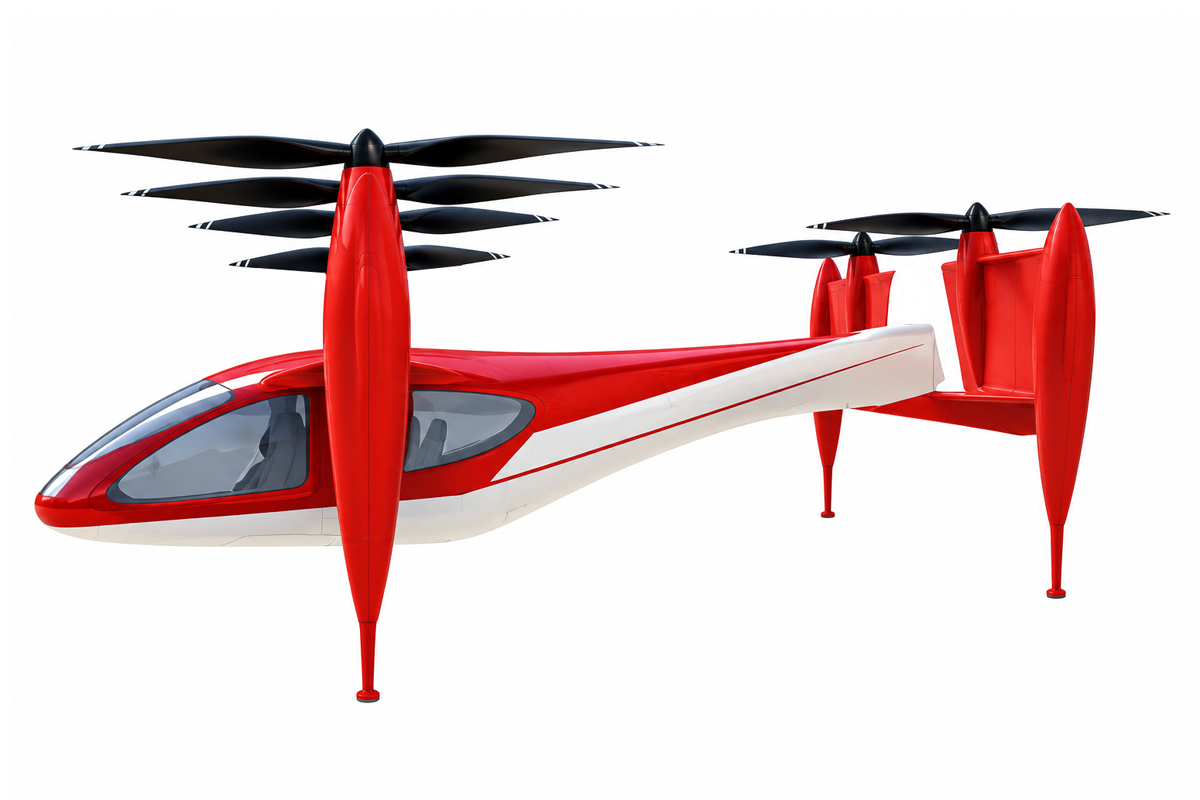
Skylark passenger eVTOL tiltwing (concept design)
The Skylark is a four passenger eVTOL concept design tiltwing aircraft. The aircraft holds one pilot, three passengers and their luggage. The range of the aircraft is extended due to the high main wing and smaller rear wing. The original graphic of this eVTOL aircraft is located inside one of NASA's papers discussing passenger eVTOL aircraft but the aircraft was never named. We named this concept design aircraft, the Skylark.
The aircraft's estimated cruise speed is unknown. The aircraft has six propellers, six electric motors and is powered by battery packs. The aircraft has four propellers on the high main tiltwing and has two propellers on the rear tiltwing. The fuselage is made from carbon fiber composite to give the aircraft a high strength to low weight ratio. For takeoff and landing, the aircraft has its tiltwings in the vertical position and for its landing gear, has landing struts at the rear of each tiltwing.
Specifications:
- Aircraft type: Long-range passenger eVTOL tiltwing aircraft (concept design)
- Piloting: 1 pilot, auto pilot or autonomous
- Capacity: 3 passengers and their luggage (If the aircraft has autonomous piloting, 4 passengers and their luggage)
- Cruise speed: Unknown
- Maximum payload weight: ~900 lb (408 kg)
- Propellers: 6 propellers (as this is a concept design, more propellers could be added to any prototype or production aircraft)
- Electric motors: 6 electric motors (depending upon the customer's need, the aircraft could have 12 electric motors)
- Power source: Battery packs
- Fuselage: Carbon fiber composite
- Windows: Panoramic wrap around windows allowing forward, left and right visibility for spectacular views with a solid roof above the passenger compartment
- Wings: 1 main high tiltwing
- Tail: 1 tiltwing
- Landing gear: 4 landing struts
- Safety features: Distributed Electric Propulsion (DEP) uses multiple propellers or electric ducted fans, each powered by electric motors, to increase safety through redundancy. If one or more components fail, the remaining ones can still ensure a safe landing. There are also redundancies of critical components in the sub-systems of the aircraft providing safety through redundancy. Having multiple redundant systems on any aircraft decreases having any single point of failure.
Related Aircraft:
- NASA Dragonfly (space probe)
- NASA Greased Lightning (defunct)
- NASA LA-8 eVTOL Testbed (prototype)
- NASA Lift+Cruise (concept design)
- NASA Multi-Tiltrotor (concept design)
- NASA Puffin (concept design)
- NASA Quadrotor (concept design)
- NASA Quiet Single Main Rotor (concept design)
- NASA Raven (concept design)
- NASA Side-by-Side (concept design)
- NASA Skylark (concept design)
- NASA Tiltduct (concept design)
- NASA Tiltwing (concept design)
Company Insights:
Resources:
- NASA website
- NASA Ames Research Center website
- NASA Langley website
- NASA Advanced Air Mobility Mission web page
- NASA Advanced Air Mobility Mission More News web page
- NASA Air Mobility Pathfinders Project web page
- NASA Air Mobility Pathfinders (AMP) Project More News web page
- NASA Advanced Air Mobility STEM Learning Module web page
- NASA Aeronautics Research Institute web page
- NASA Urban Air Mobility (UAM) Reference Vehicles web page
- NASA Facebook
- NASA Twitter
- NASA YouTube Channel
- NASA Instagram
- NASA LinkedIn
- Advanced Air Mobility Wikipedia
- Article: NASA Talk Looks at the Future of Electric Propulsion in Aviation, PR News Wire, July 9, 2015
- Article: The eVTOL is in the Details, Vertiflite, March/April 2018
- Article: Lift+Cruise, a candidate research design for the UAM airspace, Research Gate, Jan. 2021
- Article: Building the Infrastructure for Advanced Air Mobility, NASA, July 18, 2022
- Article: NASA is Creating an Advanced Air Mobility Playbook, NASA, Feb. 2, 2023
- Article: NASA’s Autonomous Aircraft Decision Tech Gets Simulated Urban Test, NASA, Feb. 24, 2023
- Article: AFWERX, NASA collaborate to develop digital Advanced Air Mobility operations center, U.S. Air Force, Nov. 28, 2023
- Article: NASA Autonomous Flight Software Successfully Used in Air Taxi Stand-Ins, NASA, Jan. 25, 2024
- Article: NASA Noise Prediction Tool Supports Users in Air Taxi Industry, NASA, Apr. 4, 2024
- Article: NASA on Advanced Air Mobility Integration, Drone Life, Apr. 30, 2024
- Article: NASA Prepares for Air Taxi Passenger Comfort Studies, NASA, June 27, 2024

Recent Pages
- NASA Skylark (concept design)
- CoolFly Urban 4 (concept design)
- CoolFly Standing Flight Platform (prototype)
- CoolFly Urban 3 (prototype)
- CoolFly Urban 2 (concept design)
- CoolFly Urban (production model)
- CoolFly Dream ST (production model)
- CoolFly Dream Pro (production model)
- CoolFly Dream (prototype)
- Velo X Aerospace Velocitor X-C (concept design)